The AI market is evolving so quickly that many companies are struggling with a fundamental question: has our organization actually implemented AI, or have we simply purchased another tool? Understanding the different AI implementation levels is essential for planning budgets, defining a technology strategy, and setting realistic expectations for return on investment.
At ITSG, we see many organizations confuse access to AI tools with actual implementation. They buy licenses, organize training sessions, and then wonder why the promised results fail to materialize. The presence of new technology does not automatically mean that processes or the way the organization operates have changed.
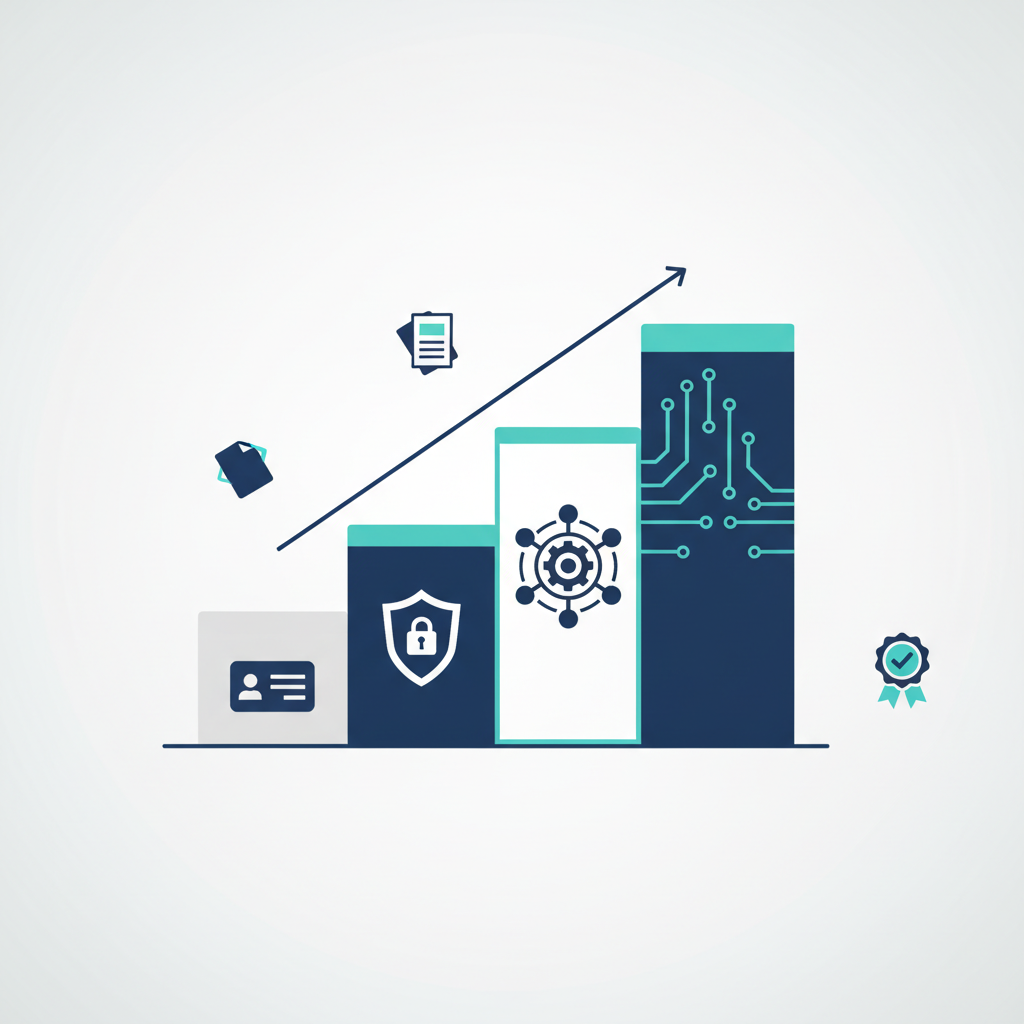
In practice, we can distinguish four AI implementation levels. They differ not only in cost and complexity, but above all in how deeply they affect the company’s day-to-day operations.
Ten artykuł jest dostępny także po polsku: Poziomy wdrożenia AI.
Level One: Purchasing Licenses as the Beginning of the Journey
The most common scenario looks like this: a company purchases Microsoft Copilot licenses or a similar solution, assigns them to employees, and considers the implementation complete. This is the simplest of the AI implementation levels, and its cost is easy to calculate: the number of users multiplied by the price of each license.
The problem is that this is not yet an implementation in the full sense of the word. It is closer to adding another application to the Microsoft 365 suite. Employees receive a new tool and begin experimenting with it. Some use it regularly, while others quickly stop paying attention to it.
From the organization’s perspective, very little changes. What appears first are the costs:
- licenses,
- optional training,
- IT support,
- time spent learning how to use the tool.
What is missing are structural changes to processes, measurable savings, and a new way of working. Employees may write emails faster or create presentations more efficiently, but the organization still operates largely as it did before.
This does not mean the step has no value. For many companies, it is a natural starting point: a way to become familiar with the technology and encourage experimentation. It should not, however, be described as a full AI implementation.
Level Two: Enterprise Tools and the First Real Challenges
The second level involves more advanced enterprise solutions, such as Claude Enterprise, Claude Code, or similar platforms. At this stage, implementation becomes more complex because the first serious questions around security and control begin to emerge.
In the simplest version, the solution can be introduced in much the same way as Copilot: the company purchases licenses for approximately EUR 20 per user, with specific token limits and access to selected models. Employees gain access to much more powerful tools that can genuinely improve their work. Claude Code, for example, performs well in document handling, analysis, and content creation.
Security Becomes Part of the Implementation
Advanced AI tools can perform multiple actions at the same time. If they receive access to all of an organization’s files, a single prompt may cause them to modify several documents. Without suitable backups, access rules, and security policies, this can create real problems.
Enterprise versions improve protection, but they do not resolve every issue automatically. An implementation still requires careful decisions about:
- access to data and documents,
- the scope of user permissions,
- monitoring the tool’s activity,
- the use of sensitive information,
- risk management and data recovery procedures.
Many companies, including us, are still learning how to introduce these solutions most effectively. There is no single established model that will work for every organization.
The cost structure also changes. In addition to licenses, the company needs to consider consultant time, security architecture, and integration with existing systems. Even so, this level is still mainly about implementing tools rather than transforming processes.
Level Three: Pilots and Solutions for Specific Departments
The third level is where tangible business value begins to emerge. The organization introduces solutions that improve specific processes in individual departments, while some tasks may be taken over by an AI agent or a network of agents.
A typical scenario looks like this: two highly capable specialists who have been experimenting with AI for some time build a solution that improves the work of their department. They create an agent, a network of agents, or an automated workflow. They then run an internal pilot, measure its effectiveness, and refine it.
The Biggest Challenge: Moving From Pilot to Scale
The problem begins when the solution needs to be made available to a larger number of employees. Not everyone is an AI expert. Not every employee wants to build tools, write prompts, or configure agents.
Most people simply want to use a ready-made solution to do their jobs, just as they use Excel, a CRM, or a financial system.
This is where platforms such as Cortex can help. They make it possible to turn a solution created for a pilot into a production-ready tool for regular users. The organization can:
- define specific use cases,
- set boundaries for the system,
- assign appropriate permissions,
- control access to data,
- make the solution available to people without technical AI expertise.
Only at this point does an internal experiment become a solution that can be implemented safely across the organization.
Pricing can no longer be calculated simply by multiplying the number of users by the cost of a license. It depends on the complexity of the process, the scope of the solution, and the number of required integrations. The investment has a clear business rationale, however, because the company can develop its own innovations and deploy them in a controlled way.
At this level, the organization genuinely begins to change. Specific processes are automated or significantly accelerated, while employees either save time or complete more work within the same number of hours.
Level Four: Process Transformation and Dedicated Systems
The highest of the AI implementation levels involves solutions that genuinely transform an organization within a particular area or process. These are no longer tools that merely support individual employees. They are systems that fundamentally change how the company operates.
Such a project requires a deep understanding of:
- the industry,
- internal processes,
- applicable regulations,
- data flows,
- technological and business risks.
Depending on the organization, industry, and ambition of the implementation, creating such a solution is a dedicated project that takes at least several months.
From a Specialist Tool to Organizational Transformation
The market is seeing a growing number of specialist solutions created by architects and IT professionals who have developed AI expertise and learned to use tools such as Claude Code. By combining technical skills with knowledge of a specific industry, they can quickly build products and sell them to other organizations as startups.
True transformation, however, occurs when large organizations, including banks, corporations, and institutions, develop similar systems for their own internal processes.
A large bank, for example, could use AI to replace 90% of its credit analysis process. Instead of a large team of analysts working manually or in spreadsheets, a smaller group of specialists would use AI tools and make the final lending decisions.
Credit analysis is already partly digital, with systems providing the necessary information. The analysis itself, however, is still often performed manually. A properly implemented AI system could:
- collect all the required data,
- carry out the analysis,
- prepare a recommendation,
- identify risks,
- pass the case to a human for review and approval.
The bank could significantly reduce costs while dramatically accelerating customer service.
A project of this kind is a major undertaking for a medium-sized or large bank. It requires access to internal process knowledge, workflow mapping, model development, testing, and implementation on secure infrastructure that guarantees data will not leave the organization. The cost may reach several million Polish zloty.
Where Does AI Implementation Really Begin?
The fundamental question is: at what point can a company genuinely say it has implemented AI? Purchasing licenses or occasionally using a tool is not enough.
Our definition is straightforward: AI implementation begins when the organization creates a solution that automates a specific process and enables employees to save a significant amount of time or complete more work within the same working hours.
This is not about writing better emails or creating more attractive proposals. It is about a process such as invoice posting, which can be automated by 70% because most invoices follow repeatable patterns.
An organization can build an agent that:
- receives an invoice,
- reads its contents,
- classifies the document,
- enters the data into the accounting system,
- passes the entry to an accountant for review and approval.
That is an AI implementation within an organizational process.
In practice, genuine implementation usually begins at level three. The earlier stages primarily involve making tools available, developing internal capabilities, and helping the organization become familiar with the technology. They are valuable, but they do not yet transform the way the company operates.
How Should Organizations Think About Costs and Implementation Levels?
Understanding AI implementation levels has a direct effect on budget planning and expectations for return on investment. Many companies make the mistake of expecting level-three or level-four results while investing only in level one.
If a provider presents an immediate fixed price, it is worth remaining cautious. A genuine implementation requires:
- diagnosing processes,
- understanding the organization’s specific circumstances,
- designing the solution,
- identifying necessary integrations,
- estimating security and maintenance costs.
A simple license calculation will never reflect the actual cost of transformation.
At the same time, not every company needs to move directly to level four. For many organizations, level two or three will be the best entry point: ambitious enough to create value, but not so complex that it overwhelms the business.
The implementation level should match the organization’s maturity and its specific business objectives. If the company has never worked with AI before, it may make sense to begin with level one and experiment. Once concrete needs and opportunities emerge, it can move to a more advanced stage.
The Future of AI Implementation Levels
The market is maturing quickly. What we currently describe as level four, involving complex and dedicated systems, may become much more accessible within a year. Tools are becoming easier to use, model costs are falling, and knowledge is becoming more widely available.
The underlying principle remains the same. A genuine AI implementation is not about purchasing technology. It is about changing processes.
The key question is not whether a company has licenses for the latest models. It is whether those models genuinely change how the organization creates value.
Companies that understand this and select an implementation level suited to their capabilities can build a lasting competitive advantage. Organizations that merely purchase tools and expect them to implement themselves are likely to pay for the illusion of progress.
FAQ
Is level one really an AI implementation? It is primarily the provision of AI tools rather than an implementation in the full sense. It has value as an educational stage and a way to develop a culture of experimentation, but it does not transform the organization’s processes.
At which level should a small company begin? Small companies can begin at level two, using enterprise tools supported by appropriate security and governance rules, and then move relatively quickly to level three by developing solutions for key processes. Their advantage is greater flexibility and a shorter decision-making path.
How long does a level-three implementation take? Typically, it takes between two and four months to move from diagnosis to a working solution for the first process. Expanding the solution to additional areas can then proceed much more quickly.
Can an organization skip the earlier levels and move directly to level four? It can, but the risk is substantial. Without experience from the earlier stages, the organization may not understand how AI behaves within its processes, where the main pitfalls lie, or how to manage the associated risks.
How can you tell whether a provider is proposing the right level? Ask: “How will this solution change a specific process in our organization?” If the answer is simply that employees will gain access to a tool, the proposal is probably at level one or two. If the provider can explain how a defined process will be automated to a measurable extent, it is more likely to be a level-three or level-four implementation.
Start With the Process, Not the Tool
The first step should not be purchasing another license. It should be identifying the processes that consume the most time, involve repetitive work, or are critical to the organization.
Choose three such areas. They are natural candidates for a level-three AI implementation, where genuine transformation begins.
If you would like to assess which AI implementation level your organization has reached and which processes should be automated first, talk to our team. We can help you conduct an audit, select the right pilot, and design a solution aligned with your actual business needs.