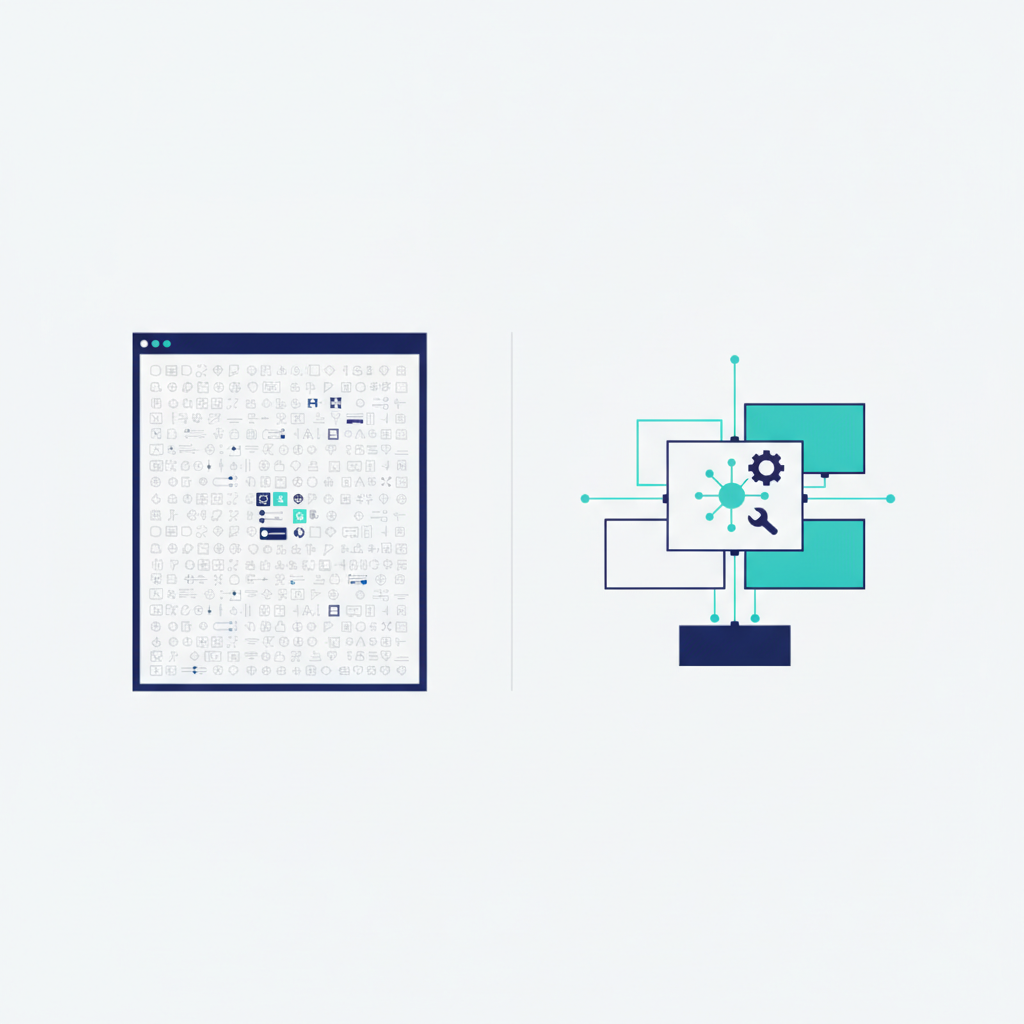
Companies are increasingly asking themselves whether they really need another large SaaS platform, especially when they only use a fraction of its features in practice. With AI, it is now possible to test and build tools tailored to specific processes much faster - without starting with a months-long IT project.
This does not mean that every prototype should be treated as a ready-made system. Custom AI solutions make sense when a company understands two things: how to test an idea quickly, and what needs to happen afterward to make the solution stable, secure, and scalable.
This is what this article is about: when custom AI solutions can be a better choice than another SaaS tool, where a fast prototype ends, and where a real production implementation begins.
Ten artykuł jest dostępny także po polsku: Dedykowane rozwiązania AI: budować czy kupić SaaS.
Why Companies Are Starting to Think About Custom AI Solutions
In many companies, the situation looks similar. You buy a large tool with a huge number of features, configuration options, and capabilities. Then, after implementation, it turns out that users only rely on a small part of the platform.
In practice, they use a handful of buttons and a few specific processes. The rest may be theoretically useful, but it does not contribute much to the company’s actual results.
This is where custom AI solutions come in. If the process owner knows exactly what the team needs, they can build a tool that supports the processes people actually use.
That means:
- no oversized platform,
- no paying for features nobody uses,
- no months-long effort to adapt a system to how the team really works,
- and no unnecessary complexity around a process that could be handled more precisely.
Some companies have already replaced selected SaaS subscriptions with their own AI-based tools. This does not mean replacing the entire technology stack. It means identifying specific areas where a large platform is only partially used, and where a custom solution can better match the real workflow.
Large SaaS Platform or Custom AI Solution?
Let’s compare two different scenarios.
In the first one, you buy a large SaaS platform. The implementation takes months. Every change may require a ticket, customization, or vendor support. The cost is fixed and predictable, but often high. PLN 1,500 per month? PLN 5,000? PLN 20,000? It depends on the tool and the scale.
In the second scenario, you create a custom AI solution. You can move from idea to prototype much faster. Changes can be made around a specific process. The cost is an initial investment, followed by maintenance and further development.
So which option is better? It depends on the process.
A SaaS platform may be the right choice when:
- your needs are standard,
- the process does not change often,
- the vendor offers a proven solution,
- your company does not have the skills to build and maintain its own system.
A custom AI solution may make more sense when:
- your needs are highly specific,
- the process changes dynamically,
- you only use a small part of a large platform,
- you need a tool tailored to the way your team actually works.
This is not a simple “SaaS or AI” decision. The better question is: which processes genuinely require a large platform, and which could be handled with a lighter, faster, more precise solution?
The Speed Shift: From Months of Work to Rapid Testing
Just a few years ago, building your own tool looked very different. A company had an idea, looked for a vendor or hired a team, went through the design phase, then production, testing, fixes, and more iterations.
After many months, the client received working software. If the vendor was good, the solution was also well-designed from a UX perspective. If not, it often looked like a tool designed mainly by developers.
Today, this process can look different. With AI tools, it is possible to create a first version of a solution much faster, test it with users, and check whether the idea is worth developing further.
This is sometimes described as vibe coding or vibe engineering. In practice, it means using AI tools to produce a working version of a solution quickly enough to show it to users, test it inside a process, and decide whether it is worth continuing.
Importantly, these solutions do not have to look worse than traditional applications. A company can quickly get something that is solid from a UX, visual, and technological perspective. Something that, in the past, would have required a much larger team and a much longer development cycle.
But there is one crucial caveat: a fast prototype is not yet a production system.
A Fast Prototype Is Not a Finished System
This is one of the most common mistakes in thinking about custom AI solutions.
The pilot works. The prototype looks impressive. Users can see that the technology solves a specific problem. So the natural reaction is: if it already works, most of the job must be done.
Not always.
An AI pilot is often only one part of the full implementation. In larger organizations, it may represent around 10-15% of the journey. The rest of the work begins when the solution has to operate not in a controlled test, but in a real production environment.
During a pilot, you test assumptions. You check whether the technology works for your use case. You verify whether users want to use it. These are important questions, but they are not all the questions.
The real work starts when you need to decide:
- where the data should be hosted,
- which AI model should be used for a given process,
- how many users will use the solution at the same time,
- what performance requirements need to be met,
- whether the data can be stored in the cloud,
- whether it must remain on-premise,
- if on-premise is required - what servers and chips are needed,
- what security requirements must be met,
- how to ensure logging, traceability, and control.
Custom AI solutions in the testing phase answer the question: “Does this make sense?”
A production version must answer a different question: “Can this work securely, reliably, and repeatedly in a real organization?”
What Needs to Be Refined After the Pilot
The key difference between a pilot and a production implementation is that, after the pilot, the project starts to resemble a regular IT deployment. In the case of AI, however, there are additional decisions related to models, data, performance, and security.
In larger organizations, you need to define:
- how many users will use the solution,
- what level of performance is required,
- which model should support a specific process,
- where the data will be stored,
- whether the data can be hosted in the European Union,
- whether it must be hosted in Poland,
- whether the solution can run in the cloud,
- whether it must run on-premise,
- what requirements follow from data confidentiality,
- how the solution integrates with existing systems,
- how output quality will be maintained,
- how operating costs will be controlled,
- how the solution will work for multiple users.
If real transactions or real money flow through the system, it is not enough that the solution worked during the pilot. It has to function reliably enough for the specific process it supports.
In extreme cases, the pilot provides useful experience and direction, but the production solution has to be built almost from scratch - this time with quality, security, performance, and maintenance in mind.
When the Pilot Is Enough - and When It Is Not
Not every implementation involves a huge gap between pilot and production.
In smaller organizations - for example, with 10-15 users - the pilot can often serve as a good basis for the production version. Turning it into a tool ready for everyday use is then cheaper and faster. The split may be closer to 50-50 than 15-85.
Why? Because scale matters.
A smaller organization usually means:
- fewer users,
- simpler processes,
- fewer integrations,
- lower operational risk,
- and a better chance of reusing parts of the pilot directly.
It looks different in larger companies. There, custom AI solutions need to meet enterprise requirements: security, quality, performance, integrations, permissions, traceability, and compliance.
In such environments, the pilot is more like a roadmap. It shows what works and why, but it does not replace the full implementation.
Standard Deployment Decisions, but Higher Stakes
After the pilot, the project starts to look like a classic IT implementation. You need to involve people responsible for security, IT, compliance, procurement, and business users. There are checklists, procedures, and approvals.
This is not the most innovative part of the work. But it is critical.
AI does not remove normal requirements for software. If a solution is going to work inside a company, it still has to be secure, stable, integrated, and maintainable.
The difference is that AI allows you to reach the working prototype stage much faster. But moving that prototype into production still requires project discipline.
But You Will Not Rewrite SAP in a Month
Custom AI solutions do not mean the end of all SaaS platforms or large enterprise systems.
You will not rewrite SAP in a month. The same applies to Microsoft Dynamics. In theory, someone could try to recreate very complex systems, but no reasonable team would guarantee the quality of such a solution without the right process, testing, integrations, and control.
The more complex, critical, and deeply connected a system is to the company’s core processes, the higher the risk of replacing it. This is especially true where data, compliance, and integrations with many other systems are involved.
If a company already has ServiceNow in place, it handles thousands of tickets a day, and all necessary integrations are working, replacing it with a cheaper AI-based solution will not be simple.
The complexity of an implementation is not only about technology. It is also about:
- people,
- processes,
- training,
- responsibility,
- change management.
At the same time, we can assume that there will be fewer new, large IT implementations lasting years. Instead, companies will more often test and implement smaller, more tailored tools.
Flexibility Versus Stability
Custom AI solutions give companies flexibility. They make it possible to test an idea faster, reject what does not work faster, and develop what brings value faster.
Large platforms offer stability. They come with a broad feature set, established security mechanisms, vendor support, documentation, and predictability.
So this is not about choosing one path for everything. It is about matching the tool to the process.
If a process is core, stable, deeply integrated, and critical to the company’s operations, a large platform may be the best choice.
If a process is specific, changing, or currently handled by an oversized tool that the company uses only partially, a custom AI solution is worth considering.
In practice, the future will likely be hybrid: large systems will remain the foundation, while smaller, faster, more tailored AI tools will be built around them.
What This Means for Your Company
If you are thinking about a custom AI solution, start with a few questions.
First: does the problem really require a custom tool? If you use a large platform but rely on only a few of its features, this may be a good candidate for replacement or support through a custom solution.
Second: is the pilot meant to test the concept or become production immediately? These are two different things. In a small organization, the line may be blurry. In a larger one, pilot and production are usually two separate stages.
Third: do you understand the costs after the pilot? Budget not only for the proof of concept, but also for production implementation. In a larger organization, the pilot cost may be only one part of the overall project.
Fourth: who will maintain the solution? Custom AI is not magic. It is software that requires security, testing, maintenance, updates, and clear responsibility.
Fifth: is the solution just an add-on, or will it become part of a process? If it is supposed to have a real impact on business results, it needs to enter everyday work, data flows, and systems.
The Future: Fewer Huge Projects, More Rapid Iterations
The coming years may change the way companies approach IT. Instead of planning only large projects that take years, they will more often test many smaller ideas. Instead of buying another all-in-one platform, they will build tools precisely matched to specific processes.
This does not mean that large platforms will disappear. They will still support core, stable processes. But everything around them - specific, changing, experimental, or too small for a major implementation - may increasingly become the domain of custom AI solutions.
For managers and directors, this changes how IT projects should be evaluated.
Not only: “How much will the implementation cost?” But also: “How much will it cost to test several options quickly?”
Not only: “Which system should we buy?” But also: “Does this process really require a large platform?”
Not only: “Do we have the budget for a major project?” But also: “Do we have the skills to continuously test and implement new solutions?”
Technology is becoming more accessible. The real question is whether the company can use it in specific processes - without confusing a fast prototype with a production-ready system.
FAQ
Can small companies afford custom AI solutions? Yes. In small organizations, a pilot can often serve as a good basis for the production version, and the cost of adapting the solution is relatively low. If the tool is meant for 10-15 users, moving from pilot to production can be much simpler than in a large organization.
How long does it take to move from pilot to production? It depends on the scale and complexity of the solution. In small companies, it may take weeks or a few months. In large organizations, the timeline is longer because security, compliance, integrations with other systems, performance, and the number of users all need to be considered.
Can custom AI solutions replace existing SaaS platforms? They can replace some tools or selected processes currently handled by large platforms, especially if the company uses only a small part of their functionality. This does not mean that custom AI can easily replace critical systems such as SAP, Dynamics, or large platforms deeply integrated with the organization.
When does a custom AI solution make the most sense? It makes the most sense when the company has a specific process, understands its needs well, and currently uses a tool that is too large or too rigid for the actual way people work. A custom solution also makes sense when quickly testing several variants is more important than a months-long implementation of one large platform.
What are the biggest risks of custom AI solutions? The biggest risks are underestimating the time and cost of moving from pilot to production, lacking the skills to maintain the solution, failing to account for security and compliance requirements, and assuming too optimistically that a working prototype is already a finished system.